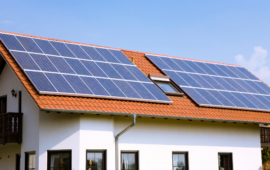


If you live anywhere in California, you already know that our utility rates are some of the highest in the entire nation. According to recent data from the U.S. Bureau of Labor Statistics, energy prices in the San Diego metro area jumped a staggering 15.9% year-over-year. It is exactly why so many of our neighbors look up at their roofs and wonder if it is finally time to make the switch to solar power.
To some people, the concept of switching to solar might feel overwhelming and confusing. Between aggressive sales pitches, complicated contracts, and shifting state regulations, it is hard to get a straight answer whether to go for it or not.
If you are sitting at your kitchen table trying to figure out if solar makes sense for your family, here is an honest look at how our energy landscape has evolved and a breakdown of the true numbers.
The Real Numbers
To make this completely clear and simple, let us look at this example. Imagine a three-bedroom, two-bathroom single-family home located right here in Escondido.
Because we experience plenty of hot inland days, a household like this usually runs the air conditioning regularly all summer, resulting in an average monthly utility bill of about $350. To completely offset that amount of electricity usage, this home would require roughly a 7.5 kilowatt solar panel system at around $21,000.
Factors to consider
NEM 3.0
To give you some context, under the old rules (NEM 2.0), the power grid acted like a friendly neighbor. During the day, your solar panels would bake way more electricity than your house could use. You would walk over to the neighbor, hand them your extra daytime electricity, and they would give you a ticket worth the exact same amount. At night, when your panels stopped working, you would just trade those tickets back to get the electricity you needed to run your TV and bedroom lights for free. It was a perfect one-to-one trade.
Under the new rules (NEM 3.0), that friendly neighbor got replaced by a tough business manager.
Now, when you try to give them your extra daytime electricity, they say, “Thanks, but I’m only going to give you twenty-five cents on the dollar for it.” They drastically cut the value of your extra power by seventy-five percent. But here is the catch: when the sun goes down and you need to get power back from them to run your house, they still charge you absolute full price.
To beat this new system, homeowners are now buying big rechargeable backup batteries for their garages. Instead of giving that extra afternoon power away to the utility company for pennies, the battery saves it right at home. When night hits, the house automatically switches over and runs on its own stored power, bypassing the utility company and their new rules completely. So, to make this system work efficiently under NEM 3.0, adding a home battery storage system will add roughly $10,000 to $12,000 to the upfront price before tax credits. While it increases the initial investment, it is the only way to completely wipe out those expensive evening utility charges.
Federal Tax Incentive
For customer-owned residential systems, the federal 30% tax credit officially expired on December 31, 2025. Homeowners installing residential systems in 2026 do not qualify for this personal tax credit. Instead, the primary way to capture this federal value today is through a solar lease, where the solar provider claims the commercial credit and passes the savings directly to you through lower monthly energy payments.
Maintenance Costs
While solar systems are mostly passive with no moving parts, keeping them running optimally over their 25-year lifespan does require some minimal budgeting. In our local climate, long, dry summers and inland dust mean that dirty panels can drop your efficiency by up to 25%. Professional cleanings run between $150-$350 per visit, which is recommended once or twice a year to maximize your production. Additionally, you should prepare for a major mid-life tune-up around year twelve or fifteen, as the system’s inverter, the brain that converts sun power into home electricity, will likely need a replacement costing between $2,500-$4,000.
Lithium-ion home batteries degrade over time just like a smartphone, meaning you should budget for an $8,000-$11,000 dollar battery replacement around year twelve or fifteen if you plan to stay in your home long-term. Averaging out these long-term numbers, setting aside roughly $200-300 dollars a year for routine cleanings and keeping a small reserve fund for mid-life hardware swaps will keep your system running perfectly for decades.
Pro-Tip: Never put solar panels on a roof that has less than ten to fifteen years of life left in it. If your roof is showing signs of wear, always handle the roofing repairs first. If your roof needs repairs midway through your panels’ lifespan, you will have to pay an installer between $2,000-$4,000 dollars purely for the labor of removing and resetting the panels.
Option A: The cash purchase / loan math
If the family buys the system outright, they bear the full, gross cost because they cannot claim a personal federal tax credit.
| $21,000 | Solar Panel (7.5 kW system) without battery backup |
| $350 | Utility Bill per month |
| $4,200 | Utility Bill per year |
| 5 years | Payback period |
| $32,000 | Solar Panel (7.5 kW system) with a battery backup |
| $350 | Utility Bill per month |
| $4,200 | Utility Bill per year |
| 7.6 years | Payback period |
Option B: The third-party lease math
Because commercial entities can still claim federal clean energy credits under Section 48E, major solar providers are utilizing a “pass-through” structure. If the family chooses a prepaid lease or a low-rate Power Purchase Agreement (PPA), the solar company takes the tax credit and passes the value down to lower the homeowner’s barrier to entry. Leasing companies are typically passing through a discount of roughly 10% to 15% of the system value via lower contract pricing or reduced prepaid costs.
| $18,000 | Solar Panel Prepaid Lease |
| $350 | Utility Bill per month |
| $4,200 | Utility Bill per year |
| 4.3 years | Lease payback timeline |
Beyond the monthly utility savings and environmental impact, installing a solar system that you own outright adds substantial equity to your property. National valuation studies show that premium solar installations increase a home’s value by an average of about 4% in competitive California markets.
Some locally based solar companies in North County San Diego
Disclaimer: We are completely independent and are not sponsored by, partnered with, or affiliated with any of the solar providers or brands mentioned in this article. Our recommendations are based purely on local industry reputation, consumer reviews, and market track records to help our North County neighbors make informed decisions. Always perform your own due diligence and gather multiple quotes before signing a contract.
Baker Electric Home Energy
2060 Wineridge Place
Escondido, CA 92029
(760) 452-9602
Stellar Solar
265 Via Del Monte
Oceanside, CA 92058
(866) 787-6527
Action Air Conditioning, Heating & Solar
130 Bosstick Blvd,
San Marcos, CA 92069
(760) 462-5641
Cosmic Solar & Roofing
943 Poinsettia Ave, Suite #401
Vista, CA 92081
(760) 394-5276
Deciding to go solar is a significant financial choice, and it completely depends on your specific roof line, your current energy usage, and how long you plan to stay in your home. Reach out to us today, and let us help you make sense of your home investments.
Sources:
- CaliforniaDGStats. California Public Utilities Commission, data current through 30 Apr. 2026, www.californiadgstats.ca.gov/.
- “Public Operational Data and Clean Energy Procurement Reports.” San Diego Community Power, sdcommunitypower.org/.
“Consumer Price Index, San Diego Area — March 2026” U.S. Bureau of Labor Statistics, U.S. Department of Labor, https://www.bls.gov/regions/west/news-release/consumerpriceindex_sandiego.htm